From Brown to Buhler: The New Force That Could Replace Rockets
NASA s lead electrostatic scientist has run 2,000 experiments on propulsionless propulsion. The results are extraordinary.

The Man Who Picked Up Where Brown Left Off
For 70 years after Thomas Townsend Brown's work was sidelined, his experiments never fully disappeared. They went underground — replicated by hobbyists, aerospace engineers working on their own time, and small teams in Japan, Germany, and the United States.
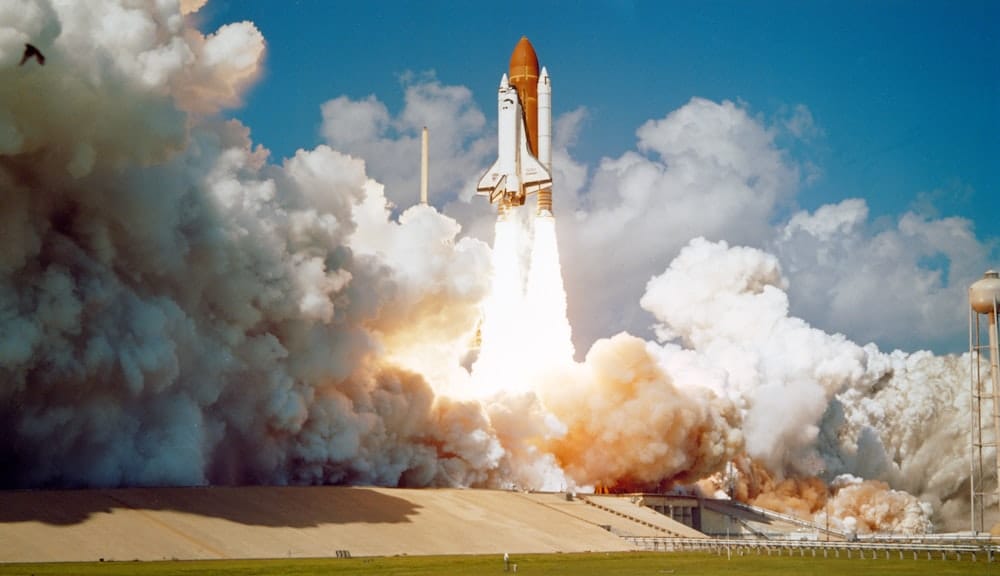
NASA Kennedy Space Center — where Buhler spent 26 years leading the Electrostatics Lab
Then came Dr. Charles Buhler.
Buhler is not a fringe scientist. He is:
- Lead scientist of NASA's Electrostatics and Surface Physics Laboratory at Kennedy Space Center (the only electrostatics lab in all of NASA)
- Incoming president of the Electrostatic Society of America
- PhD in theoretical condensed matter physics from Florida State University
- 26 years of electrostatics research
- Contributor of two novel discoveries to the field of electrostatics that are now widely accepted
His lab's Electrodynamic Dust Shield (EDS) technology successfully tested on the lunar surface in 2024 — the culmination of 25 years of work.
Important disclaimer: Buhler's propulsion research is NOT affiliated with or sanctioned by NASA. It's done independently through his company, Exodus Propulsion Technologies.
The Discovery
Buhler didn't stumble into this blindly. Since high school, he believed there had to be a better way to move objects than chemical combustion. He tailored his entire career — through graduate school, through NASA — toward understanding electrostatics deeply enough to test this belief.
In 2010, working with his mentor Dr. Sid Clemens (also an electrostatics expert), Buhler saw the force for the first time:
"We were looking at a laser on a wall. You can see small displacements of force in a chamber. He did the test and we saw the laser move. My colleague Dr. Clemens stopped what he was doing, went over... and just completely immersed himself in that experiment. It was like — what is happening here? This is really crazy."
Dr. Clemens — a world-class scientist and Buhler's own mentor — was converted on the spot.
Meeting Drew: The Parallel Path
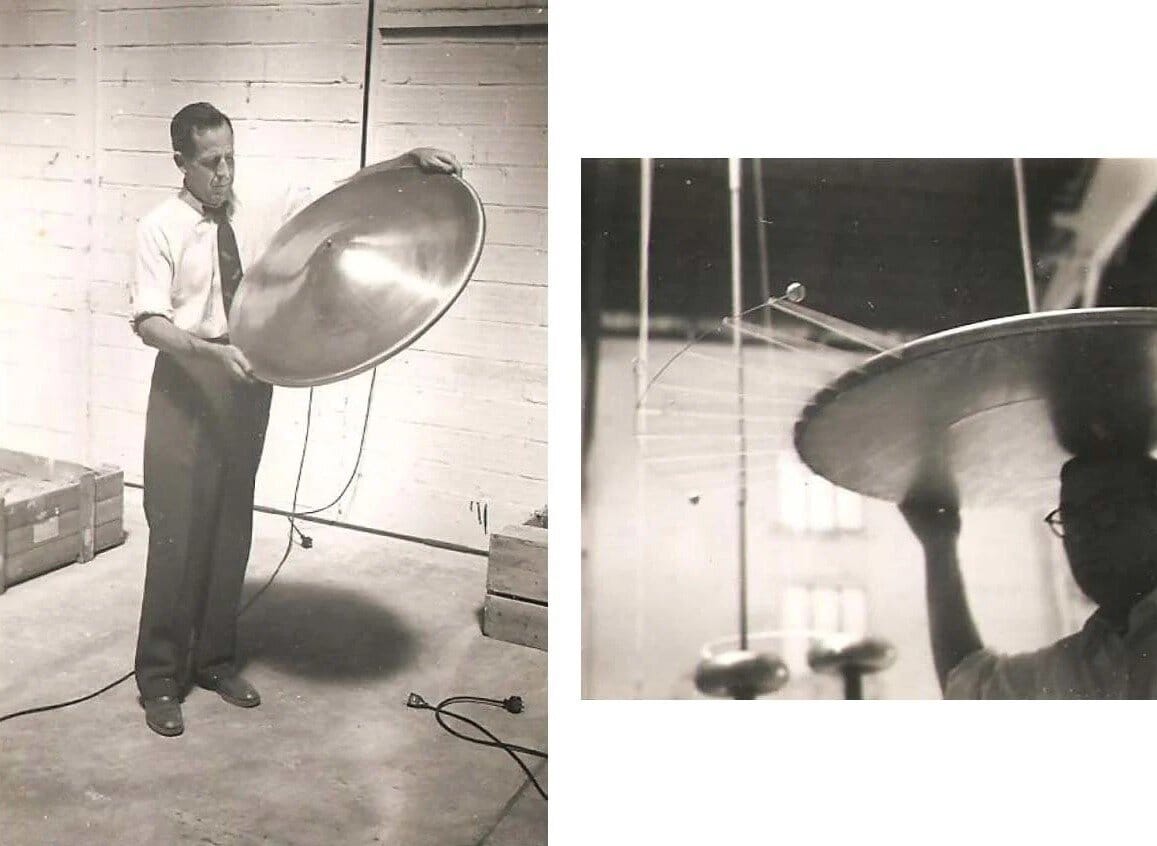
Around the same time, engineer Andrew "Drew" Aurigema was independently working on similar experiments from the Townsend Brown "electrogravitics" lineage. A mutual friend named Mike knew both of them were working on it — and never told either one.
"He was playing dumb. He knew Drew was working on it. He knew I was working on it. He just wanted to see who would win the race."
When Buhler finally visited Drew's lab, his wife — also a physicist at NASA — made the connection: "Isn't that the same force you're working on? Just manifested differently."
Buhler went back to his own lab, built a variation of Drew's setup, and watched it fly 3-4 feet in the air. He sent the video to Drew. Drew's response: "Oh, I guess we're working together now."
2,000 Experiments and Counting
Since joining forces, Buhler and Aurigema have conducted approximately 2,000 experimental variations. Not 2,000 repetitions of the same test — 2,000 different configurations, each tested multiple times.
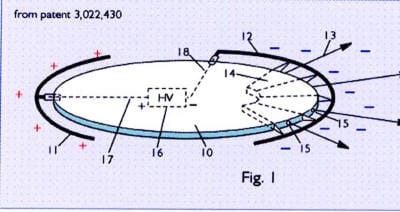
The core finding: when high voltage is applied to certain asymmetric electrostatic configurations, directional thrust is produced — with no fuel, no exhaust, and no propellant.
The Evidence
Scale tests in air:
- A thruster placed on a sensitive scale shows weight change when powered at ~480 volts
- When turned on, the scale reading drops (thrust lifts the device)
- When turned off, it returns to baseline
- When flipped upside down, the force reverses — proving it's the device creating the thrust, not external interference
Vacuum chamber tests:
- Tests in high vacuum (10⁻⁶ torr) eliminate all possibility of ion wind
- A dual thruster pack on a vertical spinner produces ~2.5 millinewtons of thrust
- Power systems are inside the chamber, connected via Bluetooth — no physical wires
- The thruster is enclosed in grounded ITO (indium tin oxide) sheathing — eliminating Coulomb attraction to walls
- The device comes on and goes off as expected
The mind-bending part:
- In certain configurations, thrust persists after power is removed
- The charged capacitor continues producing force with no energy input
- "If you were to apply that to a satellite in space in a zero gravity environment, it would accelerate with the power off. Can't explain that to the scientific community. I just can't."
Current Thrust Levels
The team has achieved forces in the 5-10 millinewton range cumulatively. While this isn't enough to lift anything in Earth's gravity (including supporting hardware), it's more than enough for:
- Satellite orbit maintenance
- Orbital transfers between orbits
- Lunar and Mars vehicles
- Deep space propulsion
As Buhler puts it: "We've hit unity for space, unity for moon, Mars, all of these places. We can make flying cars on the moon."
Controlling for Everything
The most common objection to Biefeld-Brown experiments is that the force is "just ion wind." Buhler's team has systematically eliminated every known confounding variable:
- Ion wind: Eliminated by vacuum chamber testing and sealed enclosures
- Coulomb attraction: Eliminated by Faraday cage enclosure and grounded ITO sheathing
- Magnetic effects: Eliminated by using DC only (direct current produces no magnetic field effects)
- External interference: Eliminated by rotating the device — force always follows device orientation
- Measurement artifacts: Confirmed across multiple methods — scales, pendulums, rotators, spinners
"If there is something left that could explain it, it's something quite exotic that I have no idea what it would be."
When asked how many people have thoroughly examined the experiment and remained skeptical, Buhler's answer: zero.
The Theory: Quantum Electrodynamics
Buhler isn't just collecting data — he's developing a theoretical framework using Quantum Electrodynamics (QED).
The Key Insight
Classical physics derives Coulomb's law (the force between two charges) from 2nd order perturbation theory in QED. Buhler went one step further — to 3rd order perturbation theory — and found:
- An inherent asymmetry in the charges (one charge squared × the other)
- 12 terms instead of 4
- Some Feynman diagrams show "scalar photons" being emitted but not absorbed — creating a momentum imbalance
- This could explain thrust without violating quantum conservation laws
The Fine Structure Constant
Perhaps the most compelling theoretical evidence: the fine structure constant (α) — a fundamental constant of quantum mechanics — keeps appearing in their experimental force measurements.
"There's not too many experiments you could do in your garage to get you an alpha. And that points towards quantum electrodynamics."
Independent Assessment
MIT/UCLA physicist David Chester was brought in to stress-test Buhler's theory. His assessment:
"Out of all these weird phenomena that seem to not fit into conventional theory, your experimental results got to be in the top 10 most convincing things I've seen. I can't think of any prosaic explanation."
Chester cautioned about some theoretical claims but acknowledged the experimental results are extraordinary and worthy of serious investigation.
What This Means for Humanity
If Buhler is right, the implications are staggering:
Near-term (Current thrust levels)
- Satellite station-keeping without fuel
- Orbital transfers without chemical propulsion
- Lunar and Mars surface vehicles
Medium-term (Scaled up)
- Deep space exploration without the "tyranny of the rocket equation"
- Interstellar probes
Long-term (Earth-gravity unity)
- Replacement of rockets entirely — the "self-launcher"
- A complete revolution in transportation
"We say we have an energy crisis. Oh my god, the energy crisis. Well, it could be considered an energy crisis, but it's really a force crisis. It's a transportation crisis. How do you get an object from here to here? That is the real problem." — Dr. Charles Buhler
The Path Forward
Exodus Propulsion Technologies is pursuing multiple tracks:
- Patent: Their second patent is undergoing peer review through the examiner's office, including affidavits from witnesses who have reproduced the effect
- Live demo: Buhler planned to demonstrate the effect at the Electrostatic Society of America conference in Cocoa Beach, Florida
- Open science: DIY build videos are available on exoduspropulsion.space
- Scaling: Multiple "levers" exist to increase thrust — voltage, material properties, breakdown strength, signal types, geometry
A group in Germany is currently reproducing Exodus-type experiments independently.
The Bigger Picture
Thomas Townsend Brown discovered something real in 1921. He spent 64 years trying to prove it, facing ridicule, suppression, and institutional indifference. He died in 1985 on Catalina Island, his laboratory dismantled, his life's work relegated to "fringe science."
Now, a century later, NASA's own lead electrostatic scientist — armed with modern instruments, rigorous controls, and 2,000 experimental variations — is saying the same thing Brown said:
There is a new force. And it could take us to the stars.
"This is a new force. It's just what it is. Whether it's a gravitational force or some other quantum mechanical effect, it's too important to just say 'No, no, no, I'm going to work on it until I'm done, then I'll let you see it at the end.' That's not what this should be. We need this. We need it now." — Dr. Charles Buhler
Sources:
- Jesse Michels, American Alchemy podcast: Dr. Charles Buhler interview (2.5 hours)
- The Debrief: "NASA Scientist Says Patented 'Exodus Effect' Propellantless Propulsion Drive is Ready to go to Space" (2024)
- NextBigFuture: "Exodus Propulsion and the Electrostatic Pressure Force" (2026)
- Alternative Propulsion Engineering Conference (APEC): Buhler presentations
- Hackaday: "The Myth of Propellantless Space Propulsion Refuses to Die" (2024)
- Earth.com: "NASA engineer creates propulsion system that defies physics laws"
- International Patent WO2020159603A2
Previous: The Biefeld-Brown Effect: Science or Suppression?
This article series is part of the Anti-Gravity research section on fly-ivan.com. The content is based on publicly available interviews, patents, academic papers, and historical documents. The claims presented are those of the researchers cited and do not represent established scientific consensus.